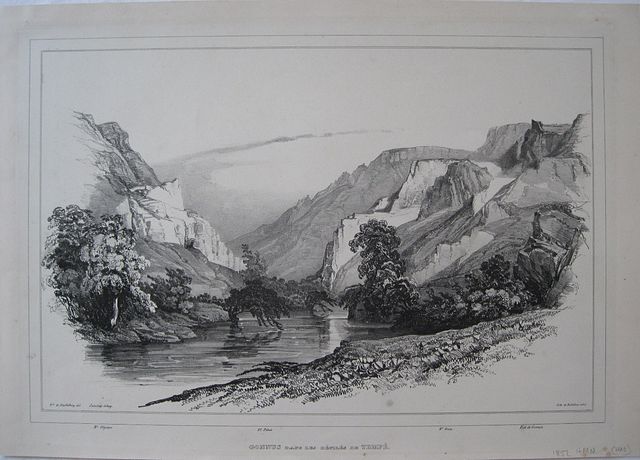
Valley of Tempe, Thessaly, Northern Greece.
Stackelberg, Otto Magnus von, Baron.
Baron de Stackelberg del . Villeneuve Lith.
Tempe. "
Gonnus dans les défilés de Tempé" Paris J.F. d'Ostervald 1829-1834
Black & white lithograph of the fort of Gonnus above the valley of Tempe from Stackelberg's
" La Grèce. Vues Pitttoresques et Topographiques." First and only edition: single page; blank verso.
John Lemprière in his Classical Dictionary gives this description: "
Tempe, (plur.) a valley in Thessaly, between mount Olympus at the north, and Ossa at the south, through which the river Peneus flows into the Ægean. The poets have described it as the most delightful spot on the earth, with continual cooling shades, and verdant walks, which the warbling of birds rendered more pleasant and romantic, and which the gods often honored with their presence. Tempe extended about five miles in length but varied in the dimensions of its breadth so as to be in some places scarce one acre and a half wide. All vallies that are pleasant, either for their situation or the mildness of their climate, are called Tempe by the poets."
Printed on india paper, mounted, generally clean; spotting to verso not showing on image; a few spots to lower image.
"
La Grèce. Vues Pittoresques et Topographiques."was published in livraisons from 1829. It appeared in an ordinary format and also with the plates on india paper, mounted. Bound copies of the complete work often contain both formats made up from different livraisons. Complete copies with all the plates are rare; the Blackmer copy had 114 of the 126 plates [including the subtitle vignettes].
Navari states;"
This is Stackelberg's chef d'oeuvre, and it is regarded by many as the most beautiful book of Greek views."
In his biography of von Stackelberg, Gerhart Rodenwaldt called him the "
discoverer of the [ancient] Greek landscape".
Count Otto Magnus ,Baron von Stackelberg
(25 July 1786 – 27 March 1837) Born in Reval (Tallinn ) Estonia. Archeologist, writer & painter.
Stackelberg travelled to Italy in 1809 and there met and became friends with the archaeologist and art historian Carl Haller von Hallerstein, & the Danish archaeologists and philologists Peter Oluf Brondsted and Georg Koes,
whom persuaded Stackelberg to accompany them on their trip to Greece. They intended to produce an archaeological publication upon their return, for which Stackelberg would produce landscapes.
The trip to Greece was long and adventurous, setting out from Naples in July 1810 and not arriving in the Piraeus until September. At Athens, they were joined by the British architects and archaeologists John Foster and Charles Robert Cockerell. The group carried out excavations at several Greek sites – in 1811 at the Temple of Aphaia at Aegina, they removed the fallen fragmentary pediment sculptures and on von Hallerstein's recommendation shipped them abroad and sold them the following year to Crown Prince Ludwig of Bavaria; and in 1812 they exposed parts of the temple of Apollo at Bassae (the frieze they found on it is now in the British Museum) and Aeacus's temple of Zeus Panhellenios (Panhellenic Zeus),again at Aegina.
In autumn 1814, Stackelberg returned from Greece to his family in the Baltic States. He travelled to Italy again in 1816, researching antiquity and the Middle Ages as an art historian and becoming co-founder of the "Instituto Archeologico Germanico" in Rome. Together with Eduard Gerhard, August Kestner and Theodor Panofka, he also established in 1824 the "Hyperboreans" ("Römischen Hyperboraeer") there, a group of northern European scholars who studied classical ruins. Both were the precursors and embryonic stages of the later German Archaeological Institute. In 1826 Stackelberg's archaeological work was published as Der Apollotempel zu Bassae in Arcadien und die daselbst ausgegrabenen Bildwerke (The Temple of Apollo at Bassae in Arcadia, and the Wall-paintings excavated there), for which he also provided the drawings. Also during this time in Rome in the middle of his life, Stackelberg undertook further trips to Greece, to Turkey and within Italy. In Etruria in 1827 he discovered the Etruscan temple and hypogaeum at Corneto (now Tarquinia)
Navari/ Blackmer: 1593; Sotheby's/Blackmer 1031 285 by 395mm (11¼ by 15½ inches) image including title.
ref: 1852
€250