MAPS & VIEWS
PRINTS
BOOKS


Rio Antirio, Achaia, Peloponessus.
 "Les Dardenelles de Lepanto" Amsterdam Wolfgangh, Waesbergen, Boom. Someren en Goethals 1688
Copper engraved birdseye view of the Rio Antirio/ Straights of Lepanto, at the entrance to the gulf of Corinth. Set in a page of Dutch text[page 20] from Olfert Dapper's" Naukeurige Beschryving van Morea" 1688. Single page; folio; text to verso Dark impression, wide margins. The text below over prints the plate mark but does not enter the printed area
131 by 168mm (5¼ by 6½ inches). €120
Chios /Scio, Northern Aegean
 Chios "Eylant Scio uist Peccatio" Amsterdam Wolfgangh, Waesbergen, Boom. Someren en Goethals 1688
Copper engraved Map of the island of Chios. Set in a page of Dutch text [page 76].
From Olfert Dapper's" Naukeurige Beschryving der Eilanden in de Archipel der Middelantsche Zee"1688. Single page, folio, text to verso. Dark impression with wide margins. Paper fault 30mm to left blank margin beside the text.
Zacharakis 1320/904 120 by 161mm (4¾ by 6¼ inches). €250
Korinthia/ Corinth, Peloponessus
 The Grave of Diogenes the Cynic "Het Graf von Diogenes Cynikus. " Amsterdam Wolfgangh, Waesbergen, Boom. Someren en Goethals
 Copper engraved view of the grave of Diogenes Cynikus. Set in a page of Dutch text[page 51] from Olfert Dapper's" Naukeurige Beschryving van Morea" 1688. Single page; folio; text to verso Dark impression, wide margins.
130 by 165mm (5 by 6½ inches). €30
Isthmus of Corinth/Korinth, Peloponessus.
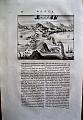 "De Stad en Kasteel van Korinthen" Amsterdam Wolfgangh, Waesbergen, Boom. Someren en Goethals 1688
Copper engraved birdseye view of the Isthmus of Corinth. Set in a page of Dutch text [page 34] from Dapper's " Naukerurige Beschryving van Morea"1688. single page; folio; text to verso.
The view shows the Isthmus of Corinth from the Peloponnesus towards Attica. with the Acrocorinth in the foreground. Dark impression, wide margins.
124 by 158mm (5 by 6¼ inches). €160
Kalamata/Calamata, Messania, Pelopenessus
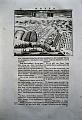 "La Bataille devant Calamata" Amsterdam Wolfgangh, Waesbergen, Boom. Someren en Goethals 1688
Copper engraved Birds eye view of the battle of Kalamata. set in a page of text in Dutch, [page 44]. From Olfert Dapper's" Beschryving van Morea "1688. Sharp impression. with wide margins, single page. foilo, text to verso.
130 by 165mm (5 by 6½ inches). €120
Pelponnesus/Morea.
 Jac. Meursium/Jacob van Meurs
"Peloponnesus sive Morea" Amsterdam Wolfgangh, Waesbergen, Boom. Someren en Goethals 1688
Jac. Meursium/Jacob van Meurs
"Peloponnesus sive Morea" Amsterdam Wolfgangh, Waesbergen, Boom. Someren en Goethals 1688Copper engraved. double page map, by Jac. Mersius from Dapper's"Beschryving van Morea" 1688. Folio, verso blank. Decorative allagorical cartouche. Dark impression with wide margins Small centre fold split to lower margin
Zacharakis 1284/872 305 by 355mm (12 by 14 inches). €750
Sitia, Crete
 "Stad Sitia of Setia" Amsterdam Wolfgangh, Waesbergen, Boom. Someren en Goethals 1688
Copper engraved birdseye view Sitia in Crete. Set in a page of Dutch text [page 215].
From Olfert Dapper's" Naukeurige Beschryving der Eilanden in de Archipel der Middelantsche Zee"1688. Single page, folio, text to verso. Dark impression with wide margins.
134 by 167mm (5¼ by 6½ inches). €140
The Dinner At Crisso.
 Dinner at Crisso. "Dinner at Crisso in the house of the Bishop of Salona." London Rodwell & Martin. 1821
Aquatint view of the dinner at Crisso from the Deluxe edition of Dodwell's "Views in Greece". Original hand colour, mounted on card with title caption to verso
The view shows the interior of the house of the Bishop of Salona, where a dinner is being served with a view of the mountains from the window.
Dodwell explains the different mountains seen on either side of the Crissæan Gulf: those on the Achaian side which join the chain of Panachaikos, and the nearer hills of Ozolæa Locris, with the town of Galaxidi on the peninsular. He continues with a description of the ceremony of Washing hands, and also of the meal that is served; a dish of pilau, rice and cooked meat, the "fine kind of bread called colouri"and the fowl brought in by the Albanian woman servant. He also explains who the various people are; the Bishop being paid homage by a Greek peasant, the local priest in the black cap, and a Greek gentleman washing his hands in a bowl held by a Christian Albanian, Bright and clean.
Atabey:357;Blackmer/Navari: 493; Abbey, Travel: 130; Colas 876; Weber I: 1110. 264 by 401mm (10½ by 15¾ inches). €2000
Edward Dodwell's Superb Views in Greece.
 Views in Greece. From Drawings By Edward Dodwell, Esq. FSA &c. London Rodwell & Martin. 1821
Folio; π1 / π3 B-Q2 [ π1: Title; [π2:prospectus/ avis [ missing] ; π3: List of plates.]
30 coloured aquatint views
First edition , ordinary format on thick paper.
Very fine contemporary polished calf, armorial crest to front and back boards, triple gilt fillets on the covers, ; spine gilt; brown morroco letterpieces;
marbled end papers; all edges gilt.
From the Library of George Granville, Leveson-Gower, 1st Duke of Sutherland (1758 -1833).
George Granville Leveson Gower was the son and heir of George, 2nd Earl Gower, afterwards Marquess of Stafford, and Louisa Egerton, daughter and eventual coheir of Scroop Egerton, 1st Duke of Bridgewater. Educated at Christ Church, Oxford, where he matriculated 3 May 1775, he was created an M.A. 31 October 1777. Elected Member of Parliament for Newcastle under Lyme 1779 1784, and for Staffordshire 1787 1799, he succeeded his father as 2nd Marquess of Stafford in 1803, was made a Knight of the Garter in 1807. He was created Duke of Sutherland 28 January 1833, a matter of months before his death.
He married, 4th September 1785, Elizabeth Sutherland, Countess of Sutherland in her own right, only daughter of William, 18th Earl of Sutherland. Infamous for his rôle in the "Highland Clearances" c 1810-1820.
Some of the books in his library belonged to his son George Granville Sutherland Leveson Gower, who became 2nd Duke of Sutherland (1786 1861) known as Lord Gower during his father's lifetime.
George Granville was created Member of Parliament for St Mawes 1808 1812, for Newcastle under Lyne 1812 1815, and for Staffordshire 1815 1820, and was summoned to the House of Lords under his father's Barony of Gower in 1826. He succeeded his father in the Dukedom in 1833. The Library of the 2nd Duke was sold at auction by Sotheby, Wilkinson & Hodge on 10 March 1892.
Text / Description of each plate in English (recto) and French (verso). 30 aquatint views in Greece:
Vol.I
1. Port Bathy, and capital of Ithaca
2. Dinner at Crisso.
3. Castalian Spring.
4. Parnassus.
5. Ruins of Orchemenos.
6. Katabathron of Lake Copais.
7. View of the Parthenon from the Propylæa.
8. West Front of the Parthenon.
9. South-West View of the Erechtheion.
10. Entrance to the Tower of the Winds.
11. Dance of the Derwisches.
12. Bazar of Athens.
13. Entrance of Athens.
14. Temple of Jupiter Olympus and River Ilissos
15. Athens from Mount Arcesmus.
16. South-East view of the temple of Sunium.
17. Temple of Jupiter Panhellenios.
18. Interior of the Same Temple.
19. Monasetry of Phineromene.
Vol II.
20. Thermopylæ
21. Village of Portaria on Mount Pelion.
22. Hyperian Spring at Phere.
23. Larissa.
24. Mount Olympus.
25. Sepulchre of Hassan Baba.
26. Gate of the Lions at Mycenæ.
27. Plain of Olympia.
28. Temple of Apollo Epicurius.
29. Lake of Stymphalos.
30. Monastery of Megaspilia in Arcadia. Binding: Very fine.
Sepia aquatint vignette to title.
Lacks the Avis Π2.
List of plates. Blanks inserted between description and each plate, with off-set to verso.
Plates have title in pencil [Binders notes?]to margin, in the 1st volume most of these are to lower margin and are bound in to the gutter so barely visable, except Plate 11 Dance of the Derwisches which is portrait . in the 2nd volume Plates 20-30 the plates are bound at upper margin, and pencil ".titles" are again just visible at the gutter.
Generally bright and clean. see list below of very minor faults.
A few plates have very light spotting , a couple entering the plate:
Plate 1. Ithaca; slight indentation to margin and one in the sky.
2. Crisso; slight indentation to margin.
9. Erechteion: light soiling to margins.
12. Bazar; light soiling to margins.
14. Jupiter Olympus; finger marks to right margin.
15. Athens from Mt.Anchesmus;Light soiling ; light spot to sky, upper left.
18. Interior Aegina; Margins lightly toned; some light spotting to sky.
22. Hyperian Fountin; light spots to sky.
25. Hassan Baba; light spots to sky.
26. Lion's Gate; light spots to sky.
29. Stymphalos; crease to upperleft margin, far from plate.
30. Mega Spillia; light soiling to margins, some minor light spotting to sky.
Blackmer/Navari: 493; Atabey:357; Abbey, Travel: 130; Colas 876; Weber I: 1110. 510 by 360mm (20 by 14¼ inches). €25000
The Agora, Athens.
 Bazar of Athens "Bazar of Athens" London Rodwell & Martin. 1821
Aquatint view of the Agora or Bazar of Athens from Dodwell's "Views in Greece". Original hand colour,
The lively scene shows the weekly market of Athens where Greeks, Turks and Albanians mingle together, along with peasants and farmers from the surrounding countryside.
Dodwell gives a full description of the prominent figures portrayed, In the coffee house where a freed slave stands leaning by a tree, the proprieter brings coffee to the Disdar or Govenor of the castle, dressed in scarlet, seateds with a Turkish Agha; standingon the step is the Vaivode or Governor of Salamis, son of Spiridon Logothetis [the late English agent], he is meeting a Greek Baratario, designated by his headgear or turban [also worn by Greek physicians]; Three turkish women stand in the centre in long white robes; to the left the Turk in green is wearing the sacred colour indicating he has performed the Hajj or pilgrimmage to Mecca.
In the background, the Acropolis with the cave of Pan and the Venetian tower near the Propylea depicted to the right of the minaret; to the left the Parthenon and Erectheion. Image bright and clean; title from verso attached below image but can be covered by mount; light foxing to surrounding card.
Blackmer/Navari: 493; Atabey:357; Abbey, Travel: 130; Colas 876; Weber I: 1110. 257 by 398mm (10 by 15¾ inches). €2500
Katabathron of Lake Kopais, Bœotia.
 Katabathron of Lake Kopais. "Katabathron of Lake Kopais." London Rodwell & Martin. 1821
Aquatint view of a Katabathron of Lake Kopais from the Deluxe edition of Dodwell's "Views in Greece". Original hand colour, mounted on card with title caption to verso.
The view shows a katabothra or underground river tunnel at Lake Kopais in Bœotia.
Dodwell says in the text that the one pictured is between the ruins of Akaiphnion and the modern town of Talanda, also that such subterranean passages were known by the ancient authors Strabo, Pausanias and Pliny, the latter describing how every nine years the lake would flood and these passages allowed the water to escape; Strabo considers they may have been caused by earthquakes.
."The basin of tho Copaic lake is surrounded by mountains and like several valleys in Arcadia its waters find outlets by subterranean channels called Katabothra"[ A Handbook for Travellers in Greece: Describing the Ionian Islands ...By John Murray ] Bright and clean.
Atabey:357;Blackmer/Navari: 493; Abbey, Travel: 130; Colas 876; Weber I: 1110. 258 by 385mm (10¼ by 15¼ inches). €350
The Lake of Stymphalia Arkadia, Peloponnesus.
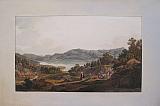 Lake of Stymphalos. "Lake of Stymphalos in Arcadia." London Rodwell & Martin. 1821
Aquatint view of the Lake of Stymphalos from the Deluxe edition of Dodwell's "Views in Greece". Original hand colour, mounted on card with title caption to verso
The view shows the small lake upon whose shores can be seen vestiges of the ancient city of Stymphalos, once one of the largest towns in Arkadia, founded by Elatos son of Arkas.
Dodwell explains that the lake is fed by two streams or springs, of which the Fountain of Stymphalos at the foot of Mount Cyllene is the most noted. The waters escape from the lake by means of a katabothra or subterranean passages; the underground river emerging at Argos where it is named Erasines, finally meeting the Argolic gulf through the marshes of Lerna.
Dodwell then mentions that the lake was the site of one of the labours of Hercules the slaying of the man-eating Stymphalian birds, and comments that he obviously did his work well as there are now only ducks and common wild fowl at the lake. Bright and clean.
Atabey:357;Blackmer/Navari: 493; Abbey, Travel: 130; Colas 876; Weber I: 1110. 234 by 390mm (9¼ by 15¼ inches). €1000
Faneromeni Monastery, Salamis.
 Monastery of Phanairomene. "Monastery of Phanairomenein the Island of Salamis." London Rodwell & Martin. 1821
Aquatint view of the Monastery of Phanairomene from the Deluxe edition of Dodwell's "Views in Greece". Original hand colour, mounted on card with title caption to verso.
The view shows the monastery on the North side of the island close to the shore of the Eleusian or Megaric gulf, in the distance the mountains of Peloponnesus. The monastery is famous for the icon of the Virgin found deep below the ground where the building now stands, discovered by Lampros Kanelos (Saint Laurentios) in the 17th century leading him to rebuild the church. Bright and clean.
Atabey:357;Blackmer/Navari: 493; Abbey, Travel: 130; Colas 876; Weber I: 1110. 234 by 414mm (9¼ by 16¼ inches). €1200
The Home of the Gods, Mount Olympus, Thessaly.
 Mount Olympos. "Mount Olympos, as seen between Larissa and Baba. ." London Rodwell & Martin. 1821
Aquatint view of Mount Olympus from Dodwell's "Views in Greece". Original hand colour.
The view shows the "rugged outline...shattered in many summits" of Mount Olympus, and the course of the river Pineios across the Pierian plain, having emerged from the vale of Tempe which Dodwell writes "diffuses its charm over the space between Ossa And Olympos."
In mythology Olympus was the Home of the twelve Gods of the Greek pantheon, whilst in Pieria, the mythological tradition had placed the nine Muses patrons of the Arts, daughters of Zeus and the Mnemosyne. Bright and clean; Short tear to upper blank margin away from image.
Blackmer/Navari: 493; Atabey:357; Abbey, Travel: 130; Colas 876; Weber I: 1110. 250 by 407mm (9¾ by 16 inches). €750
The Plain of Olympia, Elis, Peloponnesus.
 Plain of Olympia. " Plain of Olympia." London Rodwell & Martin. 1821
Aquatint view of the plain of Olympia from the Deluxe edition of Dodwell's "Views in Greece". Original hand colour, mounted on card with title caption to verso.
The view shows the course of the Alpheios river winding across the plain. Dodwell states that there is very little to be seen of the former marvels of antiquity that adorned the plain, except for the bases of a couple of columns; he goes on to encourage archeologists to follow the plan of Winkleman for excavation of the area. Bright and clean.
Atabey:357;Blackmer/Navari: 493; Abbey, Travel: 130; Colas 876; Weber I: 1110. 248 by 395mm (9¾ by 15½ inches). €750
Orchomenos, Bœotia.
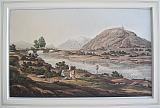 Ruins of Orchomenos. "Ruins of Orchomenos in Bœotia.". London Rodwell & Martin. 1821
Aquatint view of Orchomenos from the Deluxe edition of Dodwell's "Views in Greece". Original hand colour, mounted on card with title caption to verso
The view shows the Acropolis of Orchomenos upon an outcrop of Mount Akontios, seen from the South; the river Cephissus or Kifisos winds across the plain, with a snow covered Mount Parnassos in the background
In 1880–86, Heinrich Schliemann's excavations (H. Schliemann, Orchomenos, Leipzig 1881) revealed the tholos tomb he called the "Tomb of Minyas", a Mycenaean monument that equalled the "Tomb of Atreus" at Mycenae itself. In 1893, A. de Ridder excavated the temple of Asklepios and some burials in the Roman necropolis. In 1903–05, a Bavarian archaeological mission under Heinrich Bulle and Adolf Furtwängler conducted successful excavations at the site. Research continued in 1970–73 by the Archaeological Service under Theodore Spyropoulos, uncovering the Mycenaean palace, a prehistoric cemetery, the ancient amphitheatre, and other structures. Image bright and clean; light foxing to surrounding card away from image.
Atabey:357;Blackmer/Navari: 493; Abbey, Travel: 130; Colas 876; Weber I: 1110. 244 by 395mm (9½ by 15½ inches). €1000
The Kastallian Spring, Delphi.
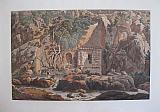 The Kastallian Spring. "The Kastallian Spring." London Rodwell & Martin. 1821
Aquatint view of the Kastallian spring, Delphi from the Deluxe edition of Dodwell's "Views in Greece". Original hand colour, mounted on card with title caption to verso.
The view shows the pool of the spring with the high cliffs behind, upon which is built the small chapel of St John, two figures appear to be fishing in the pool. Bright and clean.
Atabey:357;Blackmer/Navari: 493; Abbey, Travel: 130; Colas 876; Weber I: 1110. 255 by 395mm (10 by 15½ inches). €600
Mega Spileo, Arkadia
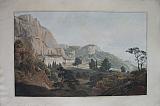 The Monastery of Megaspellia. "The Monastery of Megaspillia in Arcadia" London Rodwell & Martin. 1821
Aquatint view of the monastery of Mega Spileo from Dodwell's "Views in Greece". Original hand colour.
The view shows the monastery against the tall cliff, which made it impregnable to attackers.
The monastery, possibly the oldest in Greece, is built against a rocky cliff in Arkadia not far from Kalabryta. It takes its name from the large cave over which it is built. Light foxing to sky; short tear to lower blank margin, not close to image.
Blackmer/Navari: 493; Atabey:357; Abbey, Travel: 130; Colas 876; Weber I: 1110. 255 by 500mm (10 by 19¾ inches). €1000
Portaria, Mount Pelion, Thessaly.
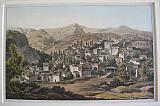 Village of Portaria. "Village of Portaria on Mount Pelion." London Rodwell & Martin. 1821
Aquatint view of Portaria from the Deluxe edition of Dodwell's "Views in Greece". Original hand colour, mounted on card with title caption to verso
The view shows Portaria, Thessaly, one of the "large and opulent " villages of Mount Pelion, inhabited by Greeks of "hardy habits and athletic forms..... in the midst of a varied profusion of trees which form cooling arbours and embowering shades,while the streets are irrigated by numerous streams that ripple under the luxuriouscanopy of wide spreading platini."Dodwell obvoiusly much enamoured of the village continues "Here is delight for the voluptuous, incitement for the romantic and repose for the weary." Bright and clean.
Atabey:357;Blackmer/Navari: 493; Abbey, Travel: 130; Colas 876; Weber I: 1110. 264 by 401mm (10½ by 15¾ inches). €2500
Crossing the Pindus Mountains.
 Dupré, Louis.
Pindus, Crossing from Joannina to Trikala. "Le Pinde, traversée de Janina à Tricala." Paris "Imprimerie de Dondey-Dupré, Rue St Louis, No 46, Au Marais." 1825-37
Dupré, Louis.
Pindus, Crossing from Joannina to Trikala. "Le Pinde, traversée de Janina à Tricala." Paris "Imprimerie de Dondey-Dupré, Rue St Louis, No 46, Au Marais." 1825-37Coloured lithograph of the artist and party crossing the Pindus Mountans from Louis Dupré's " Voyage â Athènes et â Constantinople...". Original hand colour; verso blank; blind stamp of Dupré as issued.
The print shows the artist and his fellow travellers climbing up the Pindus Mountains with the help of local guides. In the foreground a Greek dressed in fustanella leads a white horse up the mountain; behind lit by sunlight the artist, complete with portfolio, urges his horse up the rocky pass. The party is a large one with porters, mules and armed guards seemingly directed by the bearded Turk in the mid ground. The image fully shows the enterpise it was to travel through Greece at that time. Generally bright; blank margins with repaired tears, away from image; upper right corner torn and repaired to verso; slight toning to blank margins from repairs.
Colas 916; Lipperheide 1434; Droulia 901; Navari/ Blackmer: 517; Sotheby's/Blackmer 559. 430 by 320mm (17 by 12½ inches)image including title. €2500
Tartar and the Lion of Chaeronea.
 Dupré, Louis.
Tartar and Fragments of the Lion of Chaeronea. "Un Tartare et les Fragments du lion de Chéronée.." Paris "Imprimerie de Dondey-Dupré, Rue St Louis, No 46, Au Marais." 1825-37
Dupré, Louis.
Tartar and Fragments of the Lion of Chaeronea. "Un Tartare et les Fragments du lion de Chéronée.." Paris "Imprimerie de Dondey-Dupré, Rue St Louis, No 46, Au Marais." 1825-37Coloured lithograph of a tartar and his horse from Louis Dupré's " Voyage â Athènes et â Constantinople...". Original hand colour; verso blank; blind stamp of Dupré as issued.
The image shows a tartar and his magnificent horse in front of the ruined statue of the lion of Chaeronea. It is likely that the Tartar was a member of Dupré's travelling party.
The lion was rediscovered in 1818 by English travellers, and is believed to be a funerary monument erected in honor of the Sacred Band of Thebes massacred in 338BC.
Chaeronea was the site of several historical battles. Best known is that of 338 BC, between Philip II of Macedonia and a coalition of various Greek states, mainly Thebes and Athens. During the battle, the elite unit of Theban soldiers known as the Sacred Band of Thebes was wiped out completely .
Diodorus says that more than 1,000 Athenians died in the battle, with another 2,000 taken prisoner, and that the Thebans fared similarly. Plutarch suggests that all 300 of the Sacred Band were killed at the battle, having previously been seen as invincible. In the Roman period, the 'Lion of Chaeronea', an enigmatic monument on the site of the battle, was believed to mark the resting place of the Sacred Band. Modern excavations found the remains of 254 soldiers underneath the monument; it is therefore generally accepted that this was indeed the grave of the Sacred Band. Removed from a frame; even toning; colours faded; some light spotting to margins.
Colas 916; Lipperheide 1434; Droulia 901; Navari/ Blackmer: 517; Sotheby's/Blackmer 559 357 by 452mm (14 by 17¾ inches)image withou title; page:440x570mm. €1500
Meteora, Thessaly
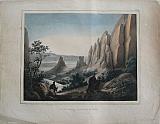 Dupré, Louis.
The Meteors of Thessaly and Pindus "Les Météores de Thessaly et Le Pinde." Paris "Imprimerie de Dondey-Dupré, Rue St Louis, No 46, Au Marais." 1825-37
Dupré, Louis.
The Meteors of Thessaly and Pindus "Les Météores de Thessaly et Le Pinde." Paris "Imprimerie de Dondey-Dupré, Rue St Louis, No 46, Au Marais." 1825-37Coloured lithograph of Meteora from Louis Dupré's " Voyage â Athènes et â Constantinople...". Original hand colour; verso blank; blind stamp of Dupré as issued.
The image shows the famous hanging monasteries of Meteora , Thessaly; three monks climb in the foreground. Light toning and spotting, heaviest to margins; 3 short tears to upper and lower edges; small worm hole within upper border, not within plate; short crayon? lineto upper pert of sky.
Colas 916; Lipperheide 1434; Droulia 901; Navari/ Blackmer: 517; Sotheby's/Blackmer 559. 380 by 428mm (15 by 16¾ inches). €1000
View of Joannina from the Lake.
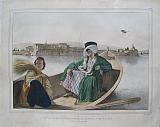 Dupré, Louis.
The Palace & Fortress of Joannina,view from the Lake "Le Palais et la Fortresse de Janina , Vue du Lac, Un Turc et un jeune Grec." Paris "Imprimerie de Dondey-Dupré, Rue St Louis, No 46, Au Marais." 1825-37
Dupré, Louis.
The Palace & Fortress of Joannina,view from the Lake "Le Palais et la Fortresse de Janina , Vue du Lac, Un Turc et un jeune Grec." Paris "Imprimerie de Dondey-Dupré, Rue St Louis, No 46, Au Marais." 1825-37Coloured lithograph of the Palace & Fort of Joannina from Louis Dupré's " Voyage â Athènes et â Constantinople...". Original hand colour; verso blank; blind stamp of Dupré as issued.
The image shows in the foreground a Turk with his Greek servant sitting in a boat on Pamvotis lake, behind is the fortress of Joannina and the palace of Ali Pasha.
Dupré, arrived in Corfu at the beginning of March 1820, whilst there he took a great interest in the Suliote heroes living in exile upon the island since Ali Pasha's conquest of the Suliotes in 1804. One of the first portraits he drew was of Photo Picos, who was surprised that Dupré knew his history.
Ironically the next portraits Dupré drew were whilst visiting Ali Pasha, in Joannina. Thomas Maitland had encouraged Dupré to show Ali his drawings, it is reported that on seeing the portrait of Photo Picos Ali exclaimed "Oh, I know him, He is one of my enemies!" Maitland suggested Ali accept the portrait as a gift, when the offer was only answered with a smile, Maitland, in an effort to maintain relations suggested Dupré draw the portrait of Ali's grandsons, which was to be the first of a number of drawings of members of Ali's household , including the Pasha himsef.
Whilst there negotiations were in progress concerning the fate of Parga.
On returning to Corfu, he drew the famous image of Nicolo Pervoli standing by the canon pointing across to the mainland.
Dupré left Corfu on the 23rd of March just a few days before 4000 exiles from Parga were to arrive in the Ionian islands. Repaired holes to image [can be seen when held to light] & to upper and lower margins; slight crease down centre.
Colas 916; Lipperheide 1434; Droulia 901; Navari/ Blackmer: 517; Sotheby's/Blackmer 559 345 by 436mm (13½ by 17¼ inches)image including title. €2000
The Parthenon, Athens.
 Dupré, Louis.
The Parthenon. "Le Parthènon." Paris "Imprimerie de Dondey-Dupré, Rue St Louis, No 46, Au Marais." 1825-37
Dupré, Louis.
The Parthenon. "Le Parthènon." Paris "Imprimerie de Dondey-Dupré, Rue St Louis, No 46, Au Marais." 1825-37Coloured lithograph of the Parthenon from Louis Dupré's " Voyage â Athènes et â Constantinople...". Original hand colour; verso blank; blind stamp of Dupré as issued.
The view shows the façade of the Parthenon upon the Acropolis. Inside the temple can be seen the mosque built by the Turks. The view also shows houses upon the Acropolis rock. Bright & clean; thinning to paper of upper margin ( due to removal of mount/passepartout?).
Colas 916; Lipperheide 1434; Droulia 901; Navari/ Blackmer: 517; Sotheby's/Blackmer 559 370 by 478mm (14½ by 18¾ inches)image including title & blind stamp. €4000
The Temple of Zeus Olympus with the Acropolis, Athens.
 Dupré, Louis.
The Temple of Jupiter Olympus and the Acropolis of Athens "Le Temple de Jupiter Olympien et l'Acropolis d'Athens." Paris "Imprimerie de Dondey-Dupré, Rue St Louis, No 46, Au Marais." 1825-37
Dupré, Louis.
The Temple of Jupiter Olympus and the Acropolis of Athens "Le Temple de Jupiter Olympien et l'Acropolis d'Athens." Paris "Imprimerie de Dondey-Dupré, Rue St Louis, No 46, Au Marais." 1825-37Coloured lithograph of the Olympieion with the Acropolis from Louis Dupré's " Voyage â Athènes et â Constantinople...". Original hand colour; verso blank; blind stamp of Dupré as issued.
The view shows the Temple of Olympian Zeus, with the Acropolis in the background; from this angle it is possible to see part of the town , the Plaka district, on the Acropolis slopes.
Interestingly Dupré illustrates a gathering of Turks beside the temple seemingly being addressed by an Imam, suggesting that the space was used as an open air mosque. Bright & clean; slight crease causing lightening of the colour of the sky in the middle of the view.
Colas 916; Lipperheide 1434; Droulia 901; Navari/ Blackmer: 517; Sotheby's/Blackmer 559 310 by 432mm (12¼ by 17 inches)image including title & blind stamp. €4000
Extremely Scarce Miniature Map of Corfu/ Kerkyra.
 Kerkyra. "Corfu Insula" Augsburg. In Verlag Jacob Enderlins/ Buchhandlers, Dructts Thomas Astler. 1687
Scarce copper engraved miniature map of Corfu/ Kerkyra from Jacob Enderlin's " Viridarii Adriatici Elysia oder Deß um den Venetianischen Golfo..." Black & white; German text to verso.
A decorative and scarce miniature map of the island showing part of the mainland coast to upper right ; compass rose ships and engraved vignette of posidon ; small title cartouche including signature of Enderlin to lower left corner. Dark impression; left margin slightly ragged but far from image
Zacherakis:1447. 122 by 76mm (4¾ by 3 inches). €350
The Herodeion, or Theatre of Herodes Atticus ,Athens.
 The Interior of the Theatre of Herodes Atticus. " Interno del Theatro di Erode Attico o Bacco.." Rome Unknown. 1844
Copper engraving of the Herodeion or Theatre of Herodes Atticus by Andrea Gasperini. Black & white; verso blank. Dedication to "Signor Alessandro Cipriani di Livorno, amatore e dislinto cultore di belle arti" with the artist's sincere friendship and gratiude.
A rare engraving, as far as we can determine it was seperately issued, ie never bound as a book with the others of the series.
The large view shows the interior of the Roman theatre built by Herodes Atticus in 174AD. Abandoned and grown over by vegetation; a place to bring cows to graze. In the foreground carved fragments of the building; in the background can be seen the monument of Phillpappos. Good dark impression; some spotting within image; tear to upper margin, repaired; lower right corner torn with loss of blank margib.
450 by 585mm (17¾ by 23 inches) plate mark. €1200
Plan of the Immortal victory of Corfu/ Kerkyra Beseiged by the Ottomans.
 Plan of the place of Corfu seiged by the infidels between the 25th July and the 22nd August ...1716. "Plan de la place de Corfu avec ses environs, assiegee par les infidels, tranchee ouvert le25em Juillet jusqu'au 22eme d Aout jour de la fuite des ottomans defendue par s.e.le Feldt Marechal comte de Schulembeourg General en chef des armées de la Serme Repque.. de Venise en l'an MDCCXV.." " Nomini Immortali Invict Corcyrae Defensoris." Nuremberg. Homann, Johann Baptist. c1716
Copper engraved plan of Corfu city/ Kerkyra by Johann Bapt. Homann. Original colour, verso blank.
The map shows the siege of the citadel of Corfu by the Ottomans between July 25 and August 22nd 1716, with the island of Vido. The image shows the fortifications and lines of attack. Set within a decorative frame with profiles of the castles in each corner; detailled key to 3 sides the plan set within a second frame. Large decorative vignette of Victory amid cannons with a portrait of Field Marshall Schulemberg, held aloft by angels.
In 1716, Corfu was the scene of one of the fiercest attacks by the Turks. Their forces were said to number 35,000 men and they besieged the citadel by land and sea. The defending forces were commanded by a distinguished German mercenary, Count Schulemberg, who was appointed by Prince Eugene of Austria. After six bloody weeks in July and August 1716 the Turks withdrew from Corfu. The cartouche on a manuscript drawing now in the British Library and probably prepared on the spot, reads:
"The Turks abandoned the Isle of Corfu with the loss of 70 pieces of cannon, 30 mortars, 2000 horses, 1500 buffalos, 1000 oxen, 3000 tents and out of 35000 men there were slain 15000 and prisoners of war 2000."
Corfu tradition has it that their patron saint, St Spiridon, appeared on his donkey accompanied by acolytes, candles in hand, and bringing a great thunderstorm. His appearance so terrified the Turks that they abandoned their encampments forthwith. It is the German cartographer Johann Baptist Homann who best captures the great battle in contemporary maps. The siege of Corfu has been called 'the last glorious military exploit in the annals of the Venetian Republic. Dark impression; bright and clean; cartouche black & white as issued; old ink number to verso
Zacharakis: 1646. 495 by 565mm (19½ by 22¼ inches). €850
Macedonia, Homeland of Alexander the Great.
 "N. Visscher excudit."
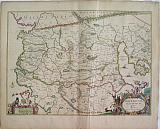
Macedonia. "Macedonia Alexandri M. Patria Illustris. Auctore J Laurenbergio." Amsterdam J. Janssonius 1650
"N. Visscher excudit."
Macedonia. "Macedonia Alexandri M. Patria Illustris. Auctore J Laurenbergio." Amsterdam J. Janssonius 1650Copper engraved map of the ancient country of Macedonia after Laurenberg by Janssonius. Original colour; verso blank.
The map shows the whole of Macedonia at the time of Alexander the Great, with Thessaly and Epirus to the South
Large decorative title cartouche [original colour] to lower right corner and scale to lower left with a strangely top hatted figure surrounded by putti. Sailing ships to sea.
The map first appeared in Janssonius' "Atlantis Majoris Quinta Pars, Orbem Maritimum" and later in 1552 in the 6th Volume entitled "Accuratissma Orbis Antiqui Delineatio Sive Geographia vetus, sacra,& profana." Good dark impression, bright colour; slight discoloration down centre fold due to guard on verso; slight creasing to right of centre fold; short tear [8mm] to lower edge; old ink number to upper right corner.
Zacharakis 1905/1276 .Koeman II; Me.164 [614] 412 by 573mm (16¼ by 22½ inches). €650
The Northern Aegean in Ancient times.
 "N. Visscher excudit."
Northern Aegean Archipelago. "Insularum Archipelagi Septrionalis seu Maris Ægæ, Accurata Delinatio Auctore J Laurenbergio." Amsterdam J. Janssonius 1650
"N. Visscher excudit."
Northern Aegean Archipelago. "Insularum Archipelagi Septrionalis seu Maris Ægæ, Accurata Delinatio Auctore J Laurenbergio." Amsterdam J. Janssonius 1650Copper engraved map of the Northern Archipelago after Laurenberg by Janssonius. Original colour; verso blank.
The map shows the Northern Aegean with the islands of the Northern Archipelago: Limnos, Mytelline, Chios Samos, Imbro etc; Mount Athos and Skyros with the Sporades to the left and the coast of Asia Minor to the right.
Decorative title cartouche [ original colour]. Sailing ships to sea. Laurenberg's map is of the area in ancient times, giving the ancient names.
The map first appeared in Janssonius' "Atlantis Majoris Quinta Pars, Orbem Maritimum" and later in 1552 in the 6th Volume entitled "Accuratissma Orbis Antiqui Delineatio Sive Geographia vetus, sacra,& profana." Good dark impression, generally bright; light offsetting and ocassional spots; short split at lower centre fold and two minor tears[ backed with archival tape].
Zacharakis 1905/1276 .Koeman II; Me.164 map 676. 485 by 582mm (19 by 23 inches). €800

Company: Bryan, Mary Louise.
Address: Ag. Andrianoy 92 , 21 100 Nafplio, Greece.
Vat No: EL 119092581