MAPS & VIEWS
PRINTS
BOOKS


The Kastallian Spring, Delphi.
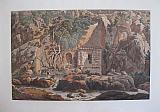 The Kastallian Spring. "The Kastallian Spring." London Rodwell & Martin. 1821
Aquatint view of the Kastallian spring, Delphi from the Deluxe edition of Dodwell's "Views in Greece". Original hand colour, mounted on card with title caption to verso.
The view shows the pool of the spring with the high cliffs behind, upon which is built the small chapel of St John, two figures appear to be fishing in the pool. Bright and clean.
Atabey:357;Blackmer/Navari: 493; Abbey, Travel: 130; Colas 876; Weber I: 1110. 255 by 395mm (10 by 15½ inches). €600
Mega Spileo, Arkadia
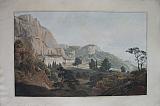 The Monastery of Megaspellia. "The Monastery of Megaspillia in Arcadia" London Rodwell & Martin. 1821
Aquatint view of the monastery of Mega Spileo from Dodwell's "Views in Greece". Original hand colour.
The view shows the monastery against the tall cliff, which made it impregnable to attackers.
The monastery, possibly the oldest in Greece, is built against a rocky cliff in Arkadia not far from Kalabryta. It takes its name from the large cave over which it is built. Light foxing to sky; short tear to lower blank margin, not close to image.
Blackmer/Navari: 493; Atabey:357; Abbey, Travel: 130; Colas 876; Weber I: 1110. 255 by 500mm (10 by 19¾ inches). €1000
Portaria, Mount Pelion, Thessaly.
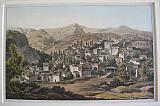 Village of Portaria. "Village of Portaria on Mount Pelion." London Rodwell & Martin. 1821
Aquatint view of Portaria from the Deluxe edition of Dodwell's "Views in Greece". Original hand colour, mounted on card with title caption to verso
The view shows Portaria, Thessaly, one of the "large and opulent " villages of Mount Pelion, inhabited by Greeks of "hardy habits and athletic forms..... in the midst of a varied profusion of trees which form cooling arbours and embowering shades,while the streets are irrigated by numerous streams that ripple under the luxuriouscanopy of wide spreading platini."Dodwell obvoiusly much enamoured of the village continues "Here is delight for the voluptuous, incitement for the romantic and repose for the weary." Bright and clean.
Atabey:357;Blackmer/Navari: 493; Abbey, Travel: 130; Colas 876; Weber I: 1110. 264 by 401mm (10½ by 15¾ inches). €2500
Celestial map of the sky, Virgo, Leo and Libra
 Celestial map of the sky in 1730. Part 4. "Globi Coelestis in tabula Planas Redact pars IV...." Nuremburg Homann Johann Baptiste 1742
Copper engraved map of the sky, from Doppelmayer's " Atlas Coelestis" original full wash colour; verso blank.
The image is part 4 of the six sheets that make up the Sky [ as seen in 1730] by Doppelmayer. It shows the constellation of Virgo, Leo and Libra amongst others. Each constellation is stunningly illustrated in 18th century German baroque style. Text to the left and right of the map proper offers coordinates for the individual stars in each constellations which are identified via an alpha-numeric code. Good impression; full original wash colour to plate; key and title uncoloured; Ink spots to lower left corner of plate.
495 by 580mm (19½ by 22¾ inches). €700
Celestial map of the sky, Scorpio, Sagittarius & Hercules.
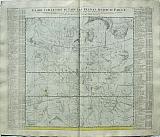 Celestial map of the sky in 1730. Part 5. "Globi Coelestis in tabula Planas Redact pars V...." Nuremburg Homann Johann Baptiste 1742
Copper engraved map of the sky, from Doppelmayer's " Atlas Coelestis" original full wash colour; verso blank.
The image is part 5 of the six sheets that make up the Sky [ as seen in 1730] by Doppelmayer. It shows the constellation of Scorpio, Sagittarius And Hercules amongst others. Each constellation is stunningly illustrated in 18th century German baroque style. Text to the left and right of the map proper offers coordinates for the individual stars in each constellations which are identified via an alpha-numeric code. Slightly faded impression; original wash colour to plate; key and title uncoloured; stain to lower left corner of plate; creasing at centrefold and 3 small wormholes.
495 by 580mm (19½ by 22¾ inches). €600
Celestial map of the sky, Argo.
 Celestial map of the sky in 1730. Part 6. "Globi Coelestis in tabula Planas Redact pars VI...." Nuremburg Homann Johann Baptiste 1742
Copper engraved map of the sky, from Doppelmayer's " Atlas Coelestis" faded wash colour; verso blank.
The image is part 6 of the six sheets that make up the Sky [ as seen in 1730] by Doppelmayer. It shows the constellation of Argo amongst other. Each constellation is stunningly illustrated in 18th century German baroque style. Text to the left and right of the map proper offers coordinates for the individual stars in each constellations which are identified via an alpha-numeric code. Slightly faded impression; original wash colour to plate, faded; key and title uncoloured; creased.
495 by 580mm (19½ by 22¾ inches). €500
Celestial map of the sky The Great Bear
 Celestial map of the sky in 1730. Part1. "Globi Coelestis in tabula Planas Redact pars I...." Nuremburg Homann Johann Baptiste 1742
Copper engraved map of the sky, from Doppelmayer's " Atlas Coelestis" original wash colour , verso blank.
The image is part1 of the six sheets that make up the Sky [ as seen in 1730] by Doppelmayer. It shows the constellation of Ursus Major or the Great Bear ; Ursus minor; Draco; Camelopardalus; Cassiopea and Perseus amongst others. Each constellation is stunningly illustrated in 18th century German baroque style. Text to the left and right of the map proper offers coordinates for the individual stars in each constellations which are identified via an alpha-numeric code. Good impression; simple wash colour to plate; keys uncoloured; printers crease to upper right of centrefold.
502 by 595mm (19¾ by 23½ inches). €750
Celestial map of the sky, Pegasus.
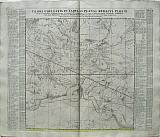 Celestial map of the sky in 1730. Part2. "Globi Coelestis in tabula Planas Redact pars II...." Nuremburg Homann Johann Baptiste 1742
Copper engraved map of the sky, from Doppelmayer's " Atlas Coelestis" original wash colour faded, verso blank.
The image is part 2 of the six sheets that make up the Sky [ as seen in 1730] by Doppelmayer. It shows the constellation of Pegasus, Andromeda and Aquarius amongst others. Each constellation is stunningly illustrated in 18th century German baroque style. Text to the left and right of the map proper offers coordinates for the individual stars in each constellations which are identified via an alpha-numeric code. Good impression; with very faded simple wash colour to plate; keys uncoloured; ink spots to upper right corner, just entering key.
495 by 580mm (19½ by 22¾ inches). €600
Celestial map of the sky, Orion, Cancer, Gemini & Taurus
 Celestial map of the sky in 1730. Part3. "Globi Coelestis in tabula Planas Redact pars III...." Nuremburg Homann Johann Baptiste 1742
Copper engraved map of the sky, from Doppelmayer's " Atlas Coelestis" original full wash colour; verso blank.
The image is part 3 of the six sheets that make up the Sky [ as seen in 1730] by Doppelmayer. It shows the constellation of Orion, Cancer, Gemini and Taurus amongst others. Each constellation is stunningly illustrated in 18th century German baroque style. Text to the left and right of the map proper offers coordinates for the individual stars in each constellations which are identified via an alpha-numeric code. Good impression; full original wash colour to plate and text.
495 by 580mm (19½ by 22¾ inches). €850
Celestial map of the sky, Virgo, Leo and Libra
 Celestial map of the sky in 1730. Part4. "Globi Coelestis in tabula Planas Redact pars IV...." Nuremburg Homann Johann Baptiste 1742
Copper engraved map of the sky, from Doppelmayer's " Atlas Coelestis" original full wash colour; verso blank.
The image is part 4 of the six sheets that make up the Sky [ as seen in 1730] by Doppelmayer. It shows the constellation of Virgo, Leo and Libra amongst others. Each constellation is stunningly illustrated in 18th century German baroque style. Text to the left and right of the map proper offers coordinates for the individual stars in each constellations which are identified via an alpha-numeric code. Good impression; full original wash colour to plate and text.
485 by 595mm (19 by 23½ inches). €850
Celestial map showing the course of Venus And Mercury
 Movement of Venus & Mercury. "Phænomena Motuum Irregularuim Venus et Mercurius...." Nuremburg Homann Johann Baptiste c1760
Copper engraved map showing the irregular movement of Venus And Mercury, from Doppelmayer's " Atlas Coelestis" original wash colour; verso blank.
Astronomical chart showing the course of the planets Venus and Mercury around the sun.; detailed text and astronomical diagrams.
The planets are illustrated in a vignette as allagorical figures in chariots; Venus accompaanied by the moon in a chariot drawn by three pairs of horses; Mercury's chariot driven by a putti is drawn by two birds; Zeus sits astride the sun. Dark impression; bright colour.
494 by 580mm (19½ by 22¾ inches). €520
Celestial map of the sky in the Southern Hemisphere.
 The Southern Sky. "Hemesphærium Coeli Australe,in quo loca Stellarum fixarum secundum Æquatorem, per Ascensiones nempe rectas et Deliniationes ad anum Christi 1750 completu sistuntur.." Nuremburg Homann Johann Baptiste c1760
Copper engraved map of the sky, from Doppelmayer's " Atlas Coelestis" original wash colour; verso blank.
by Doppelmayer. The image is of the sky in the Southern hemisphere Each constellation is stunningly illustrated in 18th century German baroque style. Text to the left and right of the map proper offers coordinates for the individual stars in each constellations which are identified via an alpha-numeric code. Surrounded by putti in each corner holding astronomical instruments Dark impression, with bright original full wash colour, surrounding putti black & white as issued; upper margin slightly short (5mm); repair to left margin replacing small loss of paper, not effecting image.
500 by 595mm (19¾ by 23½ inches). €1200
A Greek of Joannina.
 Dupré, Louis.
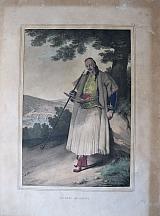
A Greek of Janina. "Un Grec de Janina." Paris "Imprimerie de Dondey-Dupré, Rue St Louis, No 46, Au Marais." 1825-37
Dupré, Louis.
A Greek of Janina. "Un Grec de Janina." Paris "Imprimerie de Dondey-Dupré, Rue St Louis, No 46, Au Marais." 1825-37Coloured lithograph of a young Greek man from Joannina from Louis Dupré's " Voyage â Athènes et â Constantinople...". Original hand colour; verso blank; blind stamp of Dupré as issued.
Standing in the countryside smoking a chibouque the young man is dressed in fustanella, with an embroidered jacket and waistcoat; he has both a sword and pistol at his waist.
Dupré, arrived in Corfu at the beginning of March 1820, whilst there he took a great interest in the Suliote heroes living in exile upon the island since Ali Pasha's conquest of the Suliotes in 1804. One of the first portraits he drew was of Photo Picos, who was surprised that Dupré knew his history.
Ironically the next portraits Dupré drew were whilst visiting Ali Pasha, in Joannina. Thomas Maitland had encouraged Dupré to show Ali his drawings, it is reported that on seeing the portrait of Photo Picos Ali exclaimed "Oh, I know him, He is one of my enemies!" Maitland suggested Ali accept the portrait as a gift, when the offer was only answered with a smile, Maitland, in an effort to maintain relations suggested Dupré draw the portrait of Ali's grandsons, which was to be the first of a number of drawings of members of Ali's household , including the Pasha himsef.
Whilst there negotiations were in progress concerning the fate of Parga.
On returning to Corfu, he drew the famous image of Nicolo Pervoli standing by the canon pointing across to the mainland.
Dupré left Corfu on the 23rd of March just a few days before 4000 exiles from Parga were to arrive in the Ionian islands. The print has been framed at sometime, probably in the 1950s thus image with some toning and discolouration to sky, otherwise bright colours; blank margins browned; repaired hole in tree by shoulder of the figure; other spots of thinning / holes in margins, repaired .
Colas 916; Lipperheide 1434; Droulia 901; Navari/ Blackmer: 517; Sotheby's/Blackmer 559 455 by 290mm (18 by 11½ inches)image including title and blindstamp. €2500
A Mamelouk.
 Dupré, Louis.
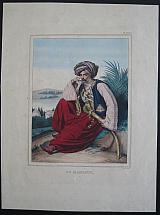
A Mamelouk. "Un Mamlouk." Paris "Imprimerie de Dondey-Dupré, Rue St Louis, No 46, Au Marais." 1825-37
Dupré, Louis.
A Mamelouk. "Un Mamlouk." Paris "Imprimerie de Dondey-Dupré, Rue St Louis, No 46, Au Marais." 1825-37Coloured lithograph of a Mamelouk from Louis Dupré's " Voyage â Athènes et â Constantinople...". Original hand colour; verso blank; blind stamp of Dupré as issued.
The image shows the heavily armed soldier seated with the Bospherous in the background.
Mamelouks were a warrior caste of slaves originally from Egypt. Islamic rulers created this warrior caste by collecting non-Muslim slave boys and training them as cavalry soldiers especially loyal to their owner and each other. They converted to Islam in the course of their training. The Mamluks were first used in Muslim armies in Baghdad by the Abbasid caliphs in the 9th cent. and quickly spread throughout the Muslim world. They eventually became so powerful that they managed to challenge the existence of the rulers who were their masters In 1250 Aybak became the first Mamelouk sultan and they would rule in Egypt and Syria for the next 250 years
Towards the end of the 15th cent. the Mamluks became involved in a war with the Ottoman Turks who captured Cairo in 1517. The Mamluks favored the cavalry and personal combat with sword and shield. They were no match for the Ottomans, who skillfully used artillery and their own slave infantry, the Janissaries, to defeat the Mamluks. The Ottoman ruler, Selim I, put an end to the Mamluk sultanate and established a small Ottoman garrison in Egypt. He did not, however, destroy the Mamluks as a class; they kept their lands, and Mamluk governors remained in control of the provinces and were even allowed to keep private armies.
In the 18th cent., when Ottoman power began to decline, the Mamluks were able to win back an increasing amount of self-rule. In 1769 one of their number, Ali Bey, even proclaimed himself sultan and independent of Constantinople. Although he fell in 1772, the Ottoman Turks still felt compelled to concede an ever greater measure of autonomy to the Mamluks and appointed a series of them as governors of Egypt. The Mamluks were defeated by Napoleon I during his invasion of Egypt in 1798, but their power as a class was ended only in 1811 by Muhammad Ali.
. Removed from a frame; Colours bright; even toning; some light spotting to margins.
Colas 916; Lipperheide 1434; Droulia 901; Navari/ Blackmer: 517; Sotheby's/Blackmer 559 330 by 257mm (13 by 10 inches) image without title; page:520x393mm. €1000
A Suliote at Corfu Nicolo Pervoli-Νικολός Περβόλης
 Dupré, Louis.
A Suliote at Corfu. "Suliote à Corfu. Nicolo Pervoli." Paris "Imprimerie de Dondey-Dupré, Rue St Louis, No 46, Au Marais." 1825-37
Dupré, Louis.
A Suliote at Corfu. "Suliote à Corfu. Nicolo Pervoli." Paris "Imprimerie de Dondey-Dupré, Rue St Louis, No 46, Au Marais." 1825-37Coloured lithograph of Nikolo Pervoli/Νικολός Περβόλης a Suliote at Corfu from Louis Dupré's " Voyage â Athènes et â Constantinople...". Original hand colour; verso blank; blind stamp of Dupré as issued.
The famous image shows Nicolo Pervoli/Νικολός Περβόλης standing by two canon with the Old Castle of Corfu behind.
Dupré, arrived in Corfu at the beginning of March 1820, whilst there he took a great interest in the Suliote heroes living in exile upon the island since Ali Pasha's conquest of the Suliotes in 1804. One of the first portraits he drew was of Photo Picos, who was surprised that Dupré knew his history. Ironically the next portraits Dupré drew were whilst visiting Ali Pasha, in Joannina. Whilst there negotiations were in progress concerning the fate of Parga.
On returning to Corfu, he drew the famous image of Nicolo Pervoli standing by the canon pointing across to the mainland.
Dupré left Corfu on the 23rd of March just a few days before 4000 exiles from Parga were to arrive in the Ionian islands. Image clean and bright; damp stain to upper left and lower blank margins , wormhole to left of lower blank margin and short tear [27 mm] at upper blank margin.
Colas 916; Lipperheide 1434; Droulia 901; Navari/ Blackmer: 517; Sotheby's/Blackmer 559 370 by 437mm (14½ by 17¼ inches). €3000
Albanian Butcher of Athens.
 Dupré, Louis.
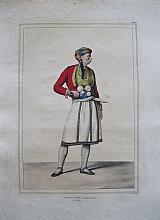
Albanian Butcher. "Un Boucher Albanais à Athènes." Paris "Imprimerie de Dondey-Dupré, Rue St Louis, No 46, Au Marais." 1825-37
Dupré, Louis.
Albanian Butcher. "Un Boucher Albanais à Athènes." Paris "Imprimerie de Dondey-Dupré, Rue St Louis, No 46, Au Marais." 1825-37Coloured lithograph of an Albanian Butcher of Athens from Louis Dupré's " Voyage â Athènes et â Constantinople...". Original hand colour; verso blank; blind stamp of Dupré as issued.
The image shows the figure standing, holding a large knife . Bright colour; light spotting of whole page ; dampstain to left blank margin; light brown stain to right of figure; wormhole to extreme right blank margin.
Colas 916; Lipperheide 1434; Droulia 901; Navari/ Blackmer: 517; Sotheby's/Blackmer 559 410 by 270mm (16¼ by 10¾ inches). €1000
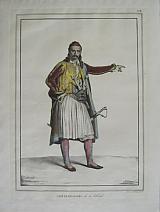
Chief of the Palikares: A Greek Soldier.
 Dupré, Louis.
Chief of the Palikaris of Selléide " Palikares de la Selléide." Paris "Imprimerie de Dondey-Dupré, Rue St Louis, No 46, Au Marais." 1825-37
Dupré, Louis.
Chief of the Palikaris of Selléide " Palikares de la Selléide." Paris "Imprimerie de Dondey-Dupré, Rue St Louis, No 46, Au Marais." 1825-37Coloured lithograph of the Chief of the Palikaris from Louis Dupré's " Voyage â Athènes et â Constantinople...". Original hand colour; verso blank; blind stamp of Dupré as issued.
A 'Palikari' is a brave young man, specifically one of those who fought the Turks during the Greek Revolution.
Dupré, arrived in Corfu at the beginning of March 1820, whilst there he took a great interest in the Suliote heroes living in exile upon the island since Ali Pasha's conquest of the Suliotes in 1804. One of the first portraits he drew was of Photo Picos, who was surprised that Dupré knew his history. Ironically the next portraits Dupré drew were whilst visiting Ali Pasha, in Joannina. Whilst there negotiations were in progress concerning the fate of Parga.
On returning to Corfu, he drew the famous image of Nicolo Pervoli standing by the canon pointing across to the mainland, and this portrait of a "Palikari" pointing to somewhere out of the image.
Dupré left Corfu on the 23rd of March just a few days before 4000 exiles from Parga were to arrive in the Ionian islands. Generally bright and clean; margins trimmed a little [ overall page size:490x367mm.
Colas 916; Lipperheide 1434; Droulia 901; Navari/ Blackmer: 517; Sotheby's/Blackmer 559 430 by 310mm (17 by 12¼ inches). €2500
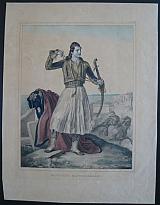
Dimitrius Mavromichalis.
 Dupré, Louis.
Dimitrius Mavromichalis "Démétrius Mavromichalis." Paris "Imprimerie de Dondey-Dupré, Rue St Louis, No 46, Au Marais." 1825-37
Dupré, Louis.
Dimitrius Mavromichalis "Démétrius Mavromichalis." Paris "Imprimerie de Dondey-Dupré, Rue St Louis, No 46, Au Marais." 1825-37Coloured lithograph of Dimitrius Mavromichalis from Louis Dupré's " Voyage â Athènes et â Constantinople...". Original hand colour; verso blank; blind stamp of Dupré as issued.
The image shows the young warrior holding a sword against a background of the wild Mani countryside and sea.
As one of the later lithographs it is more than likely that it was posed for and painted in Paris where Demetius Mavromichalis , the fifth and last son of Petrobey, Mavromichalis was studying between 1828 and 1831.
It is beleived that Dupré wished to honour the heroic history of the Mavromichalis family and its role in the Revolution. The Swiss Philhellene Jean-Gabriel Eynard isbeleived to have recommended Demetrius for his" sweet character and good behaviour" though he had reservations about the progress of his studies and the debts he was running up.
Born in !809 the youngest son of Petrobey Mavromichalis, he would have been too young to have taken an active role in the Revolution of 1821. His father became a member of the Filiki Eteria,in 1819 and in 1819 he brokered a formal pact among the major kapetanaioi families. On March 17, 1821, Petrobey raised his war flag in Areopolis, effectively signaling the start of the Greek War of Independence. His troops marched into Kalamata, and took the city on March 23. After the summer of 1822, Petrobey retired from battle, leaving the leadership of his troops to his sons (two of whom were killed fighting).
Demetrius would spend many years living in Paris and entered the military reaching the rank of major. he took an active part in the revolution of October 1862 which saw King Otto leave the country, Mavromichalis served in the interim administration and became Minister of the Military. he died in Athens in 1879. Removed from a frame; even toning; colours faded; some light spotting to margins.
Colas 916; Lipperheide 1434; Droulia 901; Navari/ Blackmer: 517; Sotheby's/Blackmer 559 425 by 335mm (16¾ by 13¼ inches) image without title; page:575x437mm. €5000
Greek Priest and A Turk.
 Dupré, Louis.
Greek Priest and A Turk. "Un Prètre Grec et un Turc." Paris "Imprimerie de Dondey-Dupré, Rue St Louis, No 46, Au Marais." 1825-37
Dupré, Louis.
Greek Priest and A Turk. "Un Prètre Grec et un Turc." Paris "Imprimerie de Dondey-Dupré, Rue St Louis, No 46, Au Marais." 1825-37Coloured lithograph of a Greek priest and a Turk from Louis Dupré's " Voyage â Athènes et â Constantinople...". Original hand colour (with some additional later colour?); verso blank; blind stamp of Dupré as issued. Generally bright; some toning. darker to lower edge and upper right corner of image; tears to right blank margin just entering image.
Colas 916; Lipperheide 1434; Droulia 901; Navari/ Blackmer: 517; Sotheby's/Blackmer 559 440 by 340mm (17¼ by 13½ inches). €1000
The Grandchildren of Ali Pascha.
 Dupré, Louis.
Ismaël & Mehemet. "ISMAÊL, Bey et mEHEMET, Pascha. Fils de Veli, Pascha de Thessalie, et Petits- fils d'Ali -Tebebeleu, Visir de Janina." Paris "Imprimerie de Dondey-Dupré, Rue St Louis, No 46, Au Marais." 1825-37
Dupré, Louis.
Ismaël & Mehemet. "ISMAÊL, Bey et mEHEMET, Pascha. Fils de Veli, Pascha de Thessalie, et Petits- fils d'Ali -Tebebeleu, Visir de Janina." Paris "Imprimerie de Dondey-Dupré, Rue St Louis, No 46, Au Marais." 1825-37Coloured lithograph of the grandchildren of Ali Pascha of Joannina from Louis Dupré's " Voyage â Athènes et â Constantinople...". Original hand colour; verso blank; blind stamp of Dupré as issued.
The portrait shows the two young men seated on a divan, in fur trimmed coats and wearing turbans each holding a chibouque, the long stemmed turkish tobacco pipe.
Dupré, arrived in Corfu at the beginning of March 1820, whilst there he took a great interest in the Suliote heroes living in exile upon the island since Ali Pasha's conquest of the Suliotes in 1804. One of the first portraits he drew was of Photo Picos, who was surprised that Dupré knew his history.
Ironically the next portraits Dupré drew were whilst visiting Ali Pasha, in Joannina. Thomas Maitland had encouraged Dupré to show Ali his drawings, it is reported that on seeing the portrait of Photo Picos Ali exclaimed "Oh, I know him, He is one of my enemies!" Maitland suggested Ali accept the portrait as a gift, when the offer was only answered with a smile, Maitland, in an effort to maintain relations suggested Dupré draw the portrait of Ali's grandsons, which was to be the first of a number of drawings of members of Ali's household , including the Pasha himsef.
Whilst there negotiations were in progress concerning the fate of Parga.
On returning to Corfu, he drew the famous image of Nicolo Pervoli standing by the canon pointing across to the mainland.
Dupré left Corfu on the 23rd of March just a few days before 4000 exiles from Parga were to arrive in the Ionian islands. Image bright and clean; dampstain to extreme left edge of paper
Colas 916; Lipperheide 1434; Droulia 901; Navari/ Blackmer: 517; Sotheby's/Blackmer 559 360 by 437mm (14¼ by 17¼ inches)Image including title and blindstamp. €2000
Kalioundji. A Military Marine of the Ottoman Navy.
 Dupré, Louis.
Kalioundji, a military marine attached to the Ottoman Navy. "Kalioundji. Marine militaire attaché à l' Amirauté Ottomane" Paris "Imprimerie de Dondey-Dupré, Rue St Louis, No 46, Au Marais." 1825-37
Dupré, Louis.
Kalioundji, a military marine attached to the Ottoman Navy. "Kalioundji. Marine militaire attaché à l' Amirauté Ottomane" Paris "Imprimerie de Dondey-Dupré, Rue St Louis, No 46, Au Marais." 1825-37Coloured lithograph of a Turkish marine from Louis Dupré's " Voyage â Athènes et â Constantinople...". Original hand colour; verso blank; blind stamp of Dupré as issued.
The image shows Kalioundji, a military marine attached to the Ottoman Admiralty; he sits casually on a bench, with a belt full of weapons. Removed from a frame; colours bright; even toning; some light spotting to margins.
Colas 916; Lipperheide 1434; Droulia 901; Navari/ Blackmer: 517; Sotheby's/Blackmer 559 480 by 296mm (19 by 11¾ inches) image without title; page:530x395mm €1000
"Photo Pikos."
 Dupré, Louis.
Photo Pikos "Photo Pikos, du Pays de Suli." Paris "Imprimerie de Dondey-Dupré, Rue St Louis, No 46, Au Marais." 1825-37
Dupré, Louis.
Photo Pikos "Photo Pikos, du Pays de Suli." Paris "Imprimerie de Dondey-Dupré, Rue St Louis, No 46, Au Marais." 1825-37Coloured lithograph " Photo Pikos" from Louis Dupré's " Voyage â Athènes et â Constantinople...". Original hand colour; verso blank; blind stamp of Dupré as issued.
The image shows Photo Pikos in typical Suliote dress with a shaggy cape, necessary for the harsh weather of the mountains of Epirus.
The Suliotes, Christian Albanians had long fought with Ali Pascha, but were to fight beside him when he went against the Supreme Port, and were to be amongst the fiercest fighters of the Greek Revolution.
Dupré, arrived in Corfu at the beginning of March 1820, whilst there he took a great interest in the Suliote heroes living in exile upon the island since Ali Pasha's conquest of the Suliotes in 1804. One of the first portraits he drew was of Photo Picos, who was surprised that Dupré knew his history. Ironically the next portraits Dupré drew were whilst visiting Ali Pasha, in Joannina where Thomas Maitland encouraged Dupré to show Ali his drawings. It is reported that on seeing the portrait of Photo Picos Ali exclaimed "Oh, I know him, He is one of my enemies!" .
Whilst there negotiations were in progress concerning the fate of Parga.
On returning to Corfu, he drew the famous image of Nicolo Pervoli standing by the canon pointing across to the mainland.
Dupré left Corfu on the 23rd of March just a few days before 4000 exiles from Parga were to arrive in the Ionian islands. Generally clean and bright, light toning to outer balnk margins [ due to former framing?].
Colas 916; Lipperheide 1434; Droulia 901; Navari/ Blackmer: 517; Sotheby's/Blackmer 559 400 by 275mm (15¾ by 10¾ inches)image with title. €2000
Crossing the Pindus Mountains.
 Dupré, Louis.
Pindus, Crossing from Joannina to Trikala. "Le Pinde, traversée de Janina à Tricala." Paris "Imprimerie de Dondey-Dupré, Rue St Louis, No 46, Au Marais." 1825-37
Dupré, Louis.
Pindus, Crossing from Joannina to Trikala. "Le Pinde, traversée de Janina à Tricala." Paris "Imprimerie de Dondey-Dupré, Rue St Louis, No 46, Au Marais." 1825-37Coloured lithograph of the artist and party crossing the Pindus Mountans from Louis Dupré's " Voyage â Athènes et â Constantinople...". Original hand colour; verso blank; blind stamp of Dupré as issued.
The print shows the artist and his fellow travellers climbing up the Pindus Mountains with the help of local guides. In the foreground a Greek dressed in fustanella leads a white horse up the mountain; behind lit by sunlight the artist, complete with portfolio, urges his horse up the rocky pass. The party is a large one with porters, mules and armed guards seemingly directed by the bearded Turk in the mid ground. The image fully shows the enterpise it was to travel through Greece at that time. Generally bright; blank margins with repaired tears, away from image; upper right corner torn and repaired to verso; slight toning to blank margins from repairs.
Colas 916; Lipperheide 1434; Droulia 901; Navari/ Blackmer: 517; Sotheby's/Blackmer 559. 430 by 320mm (17 by 12½ inches)image including title. €2500
Michael Soutzos.
 Dupré, Louis.
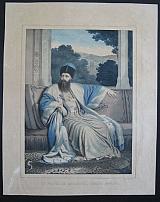
Prince of Moldavia, Michael Soutzo. "Le Prince de Moldavie. Michael Soutzo" Paris "Imprimerie de Dondey-Dupré, Rue St Louis, No 46, Au Marais." 1825-37
Dupré, Louis.
Prince of Moldavia, Michael Soutzo. "Le Prince de Moldavie. Michael Soutzo" Paris "Imprimerie de Dondey-Dupré, Rue St Louis, No 46, Au Marais." 1825-37Coloured lithograph of Michael Soutzos from Louis Dupré's " Voyage â Athènes et â Constantinople...". Original hand colour; verso blank; blind stamp of Dupré as issued.
The image shows an the Soutzos richly dressed seated on a divan his feet upon a leopard skin, with countryside seen through the window behind him.
Dupré spent three months in Constantinople in 1819, and visited Soutzos at his country estate outside the city they would renew the friendship when Soutzos was in exile, it is probable that Soutzos sat for Dupré at that time as the portrait is one of the later lithographs published.
Michael Soutzos, grandson of Michael Drakos Soutsos, who was ruler of Wallachia,and nephew of Mihai Sutu prince of Moldavia a position he would hold between 1819 & 1821. The Family were Phanariotes, , a group of wealthy Greek families who lived in Phanar the chief Greek quarter of Constantinople, where the Ecumenical Patriarchate is situated, who came to traditionally occupy four positions of major importance in the Ottoman Empire: Grand Dragoman, Grand Dragoman of the Fleet, Hospodar of Moldavia, and Hospodar of Wallachia.
Brought up in his grandfather's house hold he served as secretary of the Grand Interpreter of the Sublime Porte, Ioannis Karatzas, whose daughter, Roxanne, he married in 1812. In the same year, thanks to his knowledge of languages and the favor of his father in law, he was appointed to the position of the Grand Interpreter.
In 1819 he was placed by the Sultan as ruler of Moldavia, position he held until 1821. He also had a position in the council of Sultan Mahmud II. At the same time however he supported the rebellion of Ali Pasha in Epirus. in 1820 and in November of that year he was initiated into the Filiki Eteria by Iakovos Rizos Neroulos.
In January 1821, he collaborated with Alexander Ypsilantis, leader of the Filiki Eteria and on the 22 February Ypsilantis led the invasion of Moldavia whilst Soutzos raised the guard in command of the rebels and paid substantial amounts of money for the needs of the army. Sadly Russian support for the revolt did not come and the Boyars overthrew Soutzos, making him abdicate; for he Boyars the unpopular Greek Phanariote princes appointed over them by the Ottomans, were considered part of their oppression.
Soutzos moved to Skouleni and then to Chisinău in the Russian Empire. Both he and Ypsilantis were excommunicated by the Ecumenical Patriarchate of Constantinople during this time
Thereafter, he tried to escape to Switzerland through Austrian Empire but there he was arrested and was imprisoned for almost four years. After his release, he fled first to Italy and then to Switzerland. There, he was hosted in Geneva by the Swiss Philhellene Jean-Gabriel Eynard. During his stay in Europe, he arranged for the collection and distribution of money in favor of the Greek War of Independence and he was in contact with the "Committee of Zakynthos" of Dionysios Romas. Before Ioannis Kapodistrias, was elected head of the new Greek state, Soutsos was one of the possible candidates to occupy this position.
Under Kapodistrias he was appointed as representative of Greece to France, following the recommendation of the Eynard. Later, he was appointed by Otto of Greece as Greek ambassador in France, the Russian Empire, Sweden and Denmark. In 1839 he moved permanently to Athens and he served until 1840 as Member of the Council of the State. Removed from a frame; light even toning; colours slightly faded; some spotting to margins; tear to lower left corner (85mm) not entering plate and repaired to verso with archival tape.
Colas 916; Lipperheide 1434; Droulia 901; Navari/ Blackmer: 517; Sotheby's/Blackmer 559 407 by 318mm (16 by 12½ inches) image without title; page; 520x414mm. €3000
Princess Hélène Soutzos.
 Dupré, Louis.
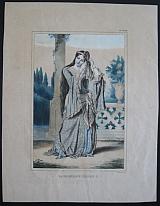
Princess Hélène Soutzos. "La Princess Hélène S.." Paris "Imprimerie de Dondey-Dupré, Rue St Louis, No 46, Au Marais." 1825-37
Dupré, Louis.
Princess Hélène Soutzos. "La Princess Hélène S.." Paris "Imprimerie de Dondey-Dupré, Rue St Louis, No 46, Au Marais." 1825-37Coloured lithograph of Princess Hélène Soutzos from Louis Dupré's " Voyage â Athènes et â Constantinople...". Original hand colour; verso blank; blind stamp of Dupré as issued.
The image shows the Princess in the garden of her fathers estate outside Constantinople.
Dupré spent three months in Constantinople in 1819, and visited Soutzos at his country estate outside the city, they would renew the friendship when Soutzos was in exile, it is probable that Hélène posed for Dupré at that time as the portrait is one of the later lithographs published,
The Princess Hélène Soutzos was identified by Dupré as Michael Soutzos' eldest daughter. Removed from a frame; even toning; colours faded; some light spotting to margins.
Colas 916; Lipperheide 1434; Droulia 901; Navari/ Blackmer: 517; Sotheby's/Blackmer 559 370 by 253mm (14½ by 10 inches)image without title; page:530x413mm. €3000
A Suliote.
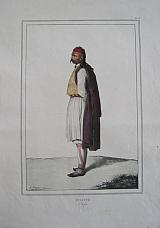 Dupré, Louis.
Suliote. "Suliote à Corfu." Paris "Imprimerie de Dondey-Dupré, Rue St Louis, No 46, Au Marais." 1825-37
Dupré, Louis.
Suliote. "Suliote à Corfu." Paris "Imprimerie de Dondey-Dupré, Rue St Louis, No 46, Au Marais." 1825-37Coloured lithograph of a Suliote from Louis Dupré's " Voyage â Athènes et â Constantinople...". Original hand colour; verso blank.
The image shows a Suliote .
Dupré, arrived in Corfu at the beginning of March 1820, whilst there he took a great interest in the Suliote heroes living in exile upon the island since Ali Pasha's conquest of the Suliotes in 1804. One of the first portraits he drew was of Photo Picos, who was surprised that Dupré knew his history. Ironically the next portraits Dupré drew were whilst visiting Ali Pasha, in Joannina. Whilst there negotiations were in progress concerning the fate of Parga.
On returning to Corfu, he drew the famous image of Nicolo Pervoli standing by the canon pointing across to the mainland.
Dupré left Corfu on the 23rd of March just a few days before 4000 exiles from Parga were to arrive in the Ionian islands. Clean And bright; two wormholes ,one within image.
Colas 916; Lipperheide 1434; Droulia 901; Navari/ Blackmer: 517; Sotheby's/Blackmer 559 430 by 273mm (17 by 10¾ inches). €2000
Tartar and the Lion of Chaeronea.
 Dupré, Louis.
Tartar and Fragments of the Lion of Chaeronea. "Un Tartare et les Fragments du lion de Chéronée.." Paris "Imprimerie de Dondey-Dupré, Rue St Louis, No 46, Au Marais." 1825-37
Dupré, Louis.
Tartar and Fragments of the Lion of Chaeronea. "Un Tartare et les Fragments du lion de Chéronée.." Paris "Imprimerie de Dondey-Dupré, Rue St Louis, No 46, Au Marais." 1825-37Coloured lithograph of a tartar and his horse from Louis Dupré's " Voyage â Athènes et â Constantinople...". Original hand colour; verso blank; blind stamp of Dupré as issued.
The image shows a tartar and his magnificent horse in front of the ruined statue of the lion of Chaeronea. It is likely that the Tartar was a member of Dupré's travelling party.
The lion was rediscovered in 1818 by English travellers, and is believed to be a funerary monument erected in honor of the Sacred Band of Thebes massacred in 338BC.
Chaeronea was the site of several historical battles. Best known is that of 338 BC, between Philip II of Macedonia and a coalition of various Greek states, mainly Thebes and Athens. During the battle, the elite unit of Theban soldiers known as the Sacred Band of Thebes was wiped out completely .
Diodorus says that more than 1,000 Athenians died in the battle, with another 2,000 taken prisoner, and that the Thebans fared similarly. Plutarch suggests that all 300 of the Sacred Band were killed at the battle, having previously been seen as invincible. In the Roman period, the 'Lion of Chaeronea', an enigmatic monument on the site of the battle, was believed to mark the resting place of the Sacred Band. Modern excavations found the remains of 254 soldiers underneath the monument; it is therefore generally accepted that this was indeed the grave of the Sacred Band. Removed from a frame; even toning; colours faded; some light spotting to margins.
Colas 916; Lipperheide 1434; Droulia 901; Navari/ Blackmer: 517; Sotheby's/Blackmer 559 357 by 452mm (14 by 17¾ inches)image withou title; page:440x570mm. €1500
Meteora, Thessaly
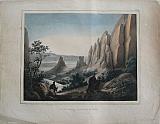 Dupré, Louis.
The Meteors of Thessaly and Pindus "Les Météores de Thessaly et Le Pinde." Paris "Imprimerie de Dondey-Dupré, Rue St Louis, No 46, Au Marais." 1825-37
Dupré, Louis.
The Meteors of Thessaly and Pindus "Les Météores de Thessaly et Le Pinde." Paris "Imprimerie de Dondey-Dupré, Rue St Louis, No 46, Au Marais." 1825-37Coloured lithograph of Meteora from Louis Dupré's " Voyage â Athènes et â Constantinople...". Original hand colour; verso blank; blind stamp of Dupré as issued.
The image shows the famous hanging monasteries of Meteora , Thessaly; three monks climb in the foreground. Light toning and spotting, heaviest to margins; 3 short tears to upper and lower edges; small worm hole within upper border, not within plate; short crayon? lineto upper pert of sky.
Colas 916; Lipperheide 1434; Droulia 901; Navari/ Blackmer: 517; Sotheby's/Blackmer 559. 380 by 428mm (15 by 16¾ inches). €1000
The Page of the Veli, Thessaly.
 Dupré, Louis.
The Page of the Veli, Pascha of Thessaly. "Un Page de Veli, Pascha de Thessalie." Paris "Imprimerie de Dondey-Dupré, Rue St Louis, No 46, Au Marais." 1825-37
Dupré, Louis.
The Page of the Veli, Pascha of Thessaly. "Un Page de Veli, Pascha de Thessalie." Paris "Imprimerie de Dondey-Dupré, Rue St Louis, No 46, Au Marais." 1825-37Coloured lithograph of the young page to the Veli or Pascha of Thessaly from Louis Dupré's " Voyage â Athènes et â Constantinople...". Original hand colour (with some additional later colour?); verso blank; blind stamp of Dupré as issued. Generally bright; removed from frame hence page cut down (page size: 485x370mm); short tear to upper edge(13mm).
Colas 916; Lipperheide 1434; Droulia 901; Navari/ Blackmer: 517; Sotheby's/Blackmer 559 400 by 265mm (15¾ by 10½ inches). €1500
View of Joannina from the Lake.
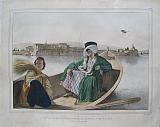 Dupré, Louis.
The Palace & Fortress of Joannina,view from the Lake "Le Palais et la Fortresse de Janina , Vue du Lac, Un Turc et un jeune Grec." Paris "Imprimerie de Dondey-Dupré, Rue St Louis, No 46, Au Marais." 1825-37
Dupré, Louis.
The Palace & Fortress of Joannina,view from the Lake "Le Palais et la Fortresse de Janina , Vue du Lac, Un Turc et un jeune Grec." Paris "Imprimerie de Dondey-Dupré, Rue St Louis, No 46, Au Marais." 1825-37Coloured lithograph of the Palace & Fort of Joannina from Louis Dupré's " Voyage â Athènes et â Constantinople...". Original hand colour; verso blank; blind stamp of Dupré as issued.
The image shows in the foreground a Turk with his Greek servant sitting in a boat on Pamvotis lake, behind is the fortress of Joannina and the palace of Ali Pasha.
Dupré, arrived in Corfu at the beginning of March 1820, whilst there he took a great interest in the Suliote heroes living in exile upon the island since Ali Pasha's conquest of the Suliotes in 1804. One of the first portraits he drew was of Photo Picos, who was surprised that Dupré knew his history.
Ironically the next portraits Dupré drew were whilst visiting Ali Pasha, in Joannina. Thomas Maitland had encouraged Dupré to show Ali his drawings, it is reported that on seeing the portrait of Photo Picos Ali exclaimed "Oh, I know him, He is one of my enemies!" Maitland suggested Ali accept the portrait as a gift, when the offer was only answered with a smile, Maitland, in an effort to maintain relations suggested Dupré draw the portrait of Ali's grandsons, which was to be the first of a number of drawings of members of Ali's household , including the Pasha himsef.
Whilst there negotiations were in progress concerning the fate of Parga.
On returning to Corfu, he drew the famous image of Nicolo Pervoli standing by the canon pointing across to the mainland.
Dupré left Corfu on the 23rd of March just a few days before 4000 exiles from Parga were to arrive in the Ionian islands. Repaired holes to image [can be seen when held to light] & to upper and lower margins; slight crease down centre.
Colas 916; Lipperheide 1434; Droulia 901; Navari/ Blackmer: 517; Sotheby's/Blackmer 559 345 by 436mm (13½ by 17¼ inches)image including title. €2000

Company: Bryan, Mary Louise.
Address: Ag. Andrianoy 92 , 21 100 Nafplio, Greece.
Vat No: EL 119092581